
Being in Bremen’s center, you cannot miss St. Petri Cathedral because it is one of the most impressive buildings in the town square. It is located 13 meters above sea level, on the highest elevation of a former dune on the right of the Weser River. For over 1200 years, an ecclesiastical building has stood on this site. From 789 to 1648, it served as a metropolitan catholic church. Since then, it has been a congregational protestant church. Visitors will be amazed by the harmonious blend of architectural styles. These include Romanesque, Gothic, Baroque, and Neo Byzantine styles. This variety gives the Cathedral an unique character. In this document, I would like to share with you what little I have learn about this fantastic building.
As a disclaimer, I have to say that this is not a professional paper. It is just a summary and an amateur approach to an interesting story. If you are interested in a more deeper account of the Dom’s history and architecture, I recommend you to visit //www.gebaut.eu/index.html. There you will find an amazing analysis of every aspect of the building. Also, you can visit the Dom’s official site: https://stpetridom.de/.
VIII Century, a Romanesque beginning.
The first building on this site was a modest church. It was built of wood in 789 by the Anglo-Saxon Archbishop Willehad (745-789 AD). He was consecrated by Charlemagne in 787 in Worms as the first, missionary, bishop in Saxony with his seat in Bremen. This first building was completely destroyed (presumably burned by the Saxons) before 805. It is not clear when the second building was built. However, it was Ansgar[1], «The Apostle of the North», who consecrated it around 860. Ansgar was appointed Bishop of Bremen in 847 by the King of the East Franks, Louis the German. It is believed that it was a very simple building with an altar house and atrium. It had a pre-Romanesque hall church of East Franconian type. .
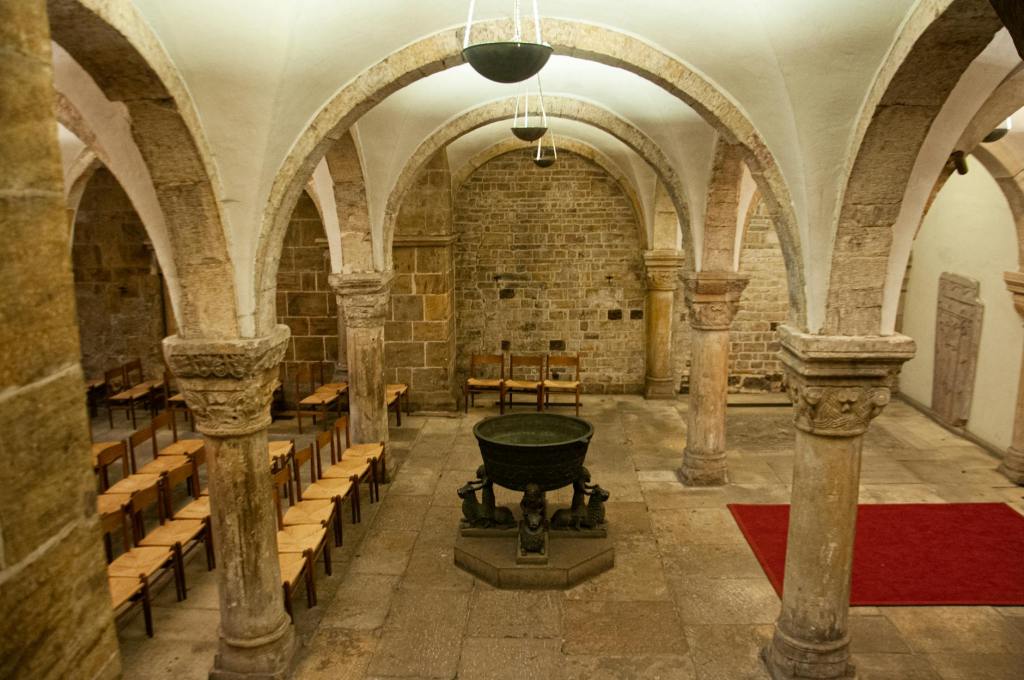
This second church stood until 1041. That year marked a notable competition. Two canons, both curiously named Edo, vied for the position of Bremen’s cathedral provost (principal/head) [2]. One of them was related to the then Archbishop of Hamburg-Bremen, Adalbrand. Therefore he thought he had an obvious advantage when it came to the appointment of the office. However, the other Edo was elected which caused profound anger in Adalbrand’s relative. His anger was so profound that he set the cathedral on fire. This fire destroyed not only the cathedral but its library, the monastery, and several houses in the area. It may be surprising, but the defeated Edo, turned arsonist, was one of the master builders in the reconstruction of the cathedral. We have to remember that he was an Archbishop’s relative after all. The cathedral was rebuilt in the measure and model of the old Cologne Cathedral (built by Charlemagne around the year 795 to celebrate the appointment of Hildebold as the first archbishop of Cologne[3]). It was decorated similarly to the cathedral of Benevento: a three-aisled, flat-roofed pillar basilica in Romanesque style with two crypts above which two choirs rise. The image above is from the second oldest room in the cathedral, the West Crypt built in 1060.
XIII to XVII Century, renewals and additions in Gothic and late Gothic Style.
The construction of the two-towered monumental west-facing entrance and the vaulting of the cathedral began around 1250. This gave the facade its early Gothic character.
In the 14th century, the building was provided with side chapels in the early Gothic style.
At the beginning of the 16th century, many renovations were made in the cathedral. In 1502, the north aisle was converted into a late Gothic Hall with a wonderful net vault. The hall has the same height and almost the same width as the central nave. Also, the west choir was converted into an organ gallery which organ was installed in 1528. In addition, the Founders Relief that is on the parapet of the organ loft was made in 1512. It was inspired by the city seal (image below). However, the upheavals caused by the Reformation and the Thirty Years’ War, prevented further renovations. After the Reform, the cathedral remained closed for religious and political reasons for decades-long periods (1532–1547 and 1561–1638).
In 1638, the south tower, which only had a cross roof, no pointed helmet, collapsed with its eight bells. After 77 years of closure, the building was opened by professing Lutherans and prepared for worship. In 1648, Prince Friedrich III was crowned King of Denmark and Norway. That same year, following the 30 years war, Bremen was secularized due to the Westphalia Treaty. Bremen was no longer an archbishopric and passed to Sweden as the Duchy of Bremen. In 1656, the north tower was stroke by a lightning. The resulting fire burned too the central nave and the stump of the south tower was open at the top.
Over the next centuries, the church received its current appearance. The pillars and walls were furnished with numerous Renaissance and Baroque epitaphs. Both cathedral clergymen and Bremen citizens contributed to these additions.
The main pulpit in early Baroque form in the central nave was presumably a gift from Queen Christina of Sweden. She gave it during the period Sweden held the power.
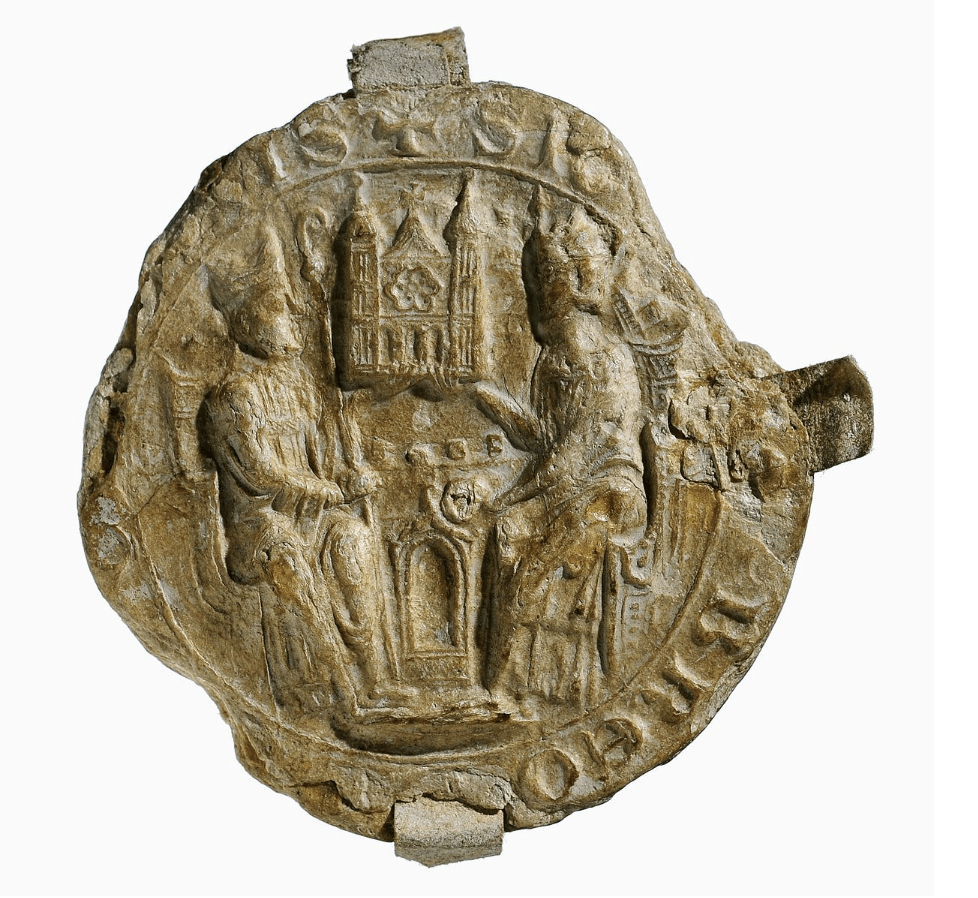
The Bremen city seal (left) is the oldest pictorial representation of the cathedral. It is believed that it was cut before 1230 since it is mentioned in a document from 1229. On it we can see Charlemagne receiving the cathedral from the founding bishop Willehad.
XIX and XX Centuries, mayor renovations, bombings and treasures discovered.
The first major cathedral restoration with new constructions (e.g. the crossing tower) took place between 1888 and 1901. The southern tower finally was rebuilt. Also the whole west façade had a renovation that give the building its current aspect. The interior was painted in accordance with the custom of the time, incorporating Neo Byzantine stylistic elements in strong colours with rich tendrils. This makes a big difference with other German cathedrals made of brick that were plastered and painted white inside.
In 1945, a bomb hit the northern part of the north aisle. It destroyed all the glass windows and 30% of the building and its furnishings. Fortunately, the first part of the reconstruction was finished by 1951.
The last major renovation in the 1970s secured the building and freed it from the last war damage. The painting was freshened up and underfloor heating in the main nave of the cathedral was installed. It was during this installation a huge archaeological discovery was made. Several medieval bishops’ burials were found. With them, the richly decorated clothing and several objects of the clergy such as rings, chalices and crooks that had been remarkably well preserved. Today all the rescued treasures can be seen in the Dom Museum (which is entrance free).
On March 01, 2023, the latest major addition to St. Petri’s Cathedral was installed. Three magnificent bells joined the existing three to reconstruct the original set of bells from 1896. These new bells were cast by the Grassmayr Bell Foundry from Innsbruck. They are an experienced company that has been casting bells since 1599. The new bells were named Creation Bell, Justice Bell and Brema Bell. The last one is replacing the original Brema that was out of service for many years due to defects. The Brema Bell is now installed in the South Tower. In the North Tower are now five bells: the new Creation Bell and Justice Bell, the Hansa Bell and Felicitas Bell from 1951 and the fantastique “Gloriosa Bell” from 1433. All the bells received new clappers.
If this post got your interest, please visit Bremen, I promise you it will totally worth your time. If so, I will be delighted to walk with you. I will introduce you not only to the magnificent cathedral but also to other Bremen’s wonders.
Finally, I leave you here the opening hours for the Cathedral and for climbing the southern tower.
Monday to Saturday: 10 a.m. – 5 p.m.
Sunday: 11.45 a.m. – 5 p.m.
[1] https://www.britannica.com/biography/Saint-Ansgar
[2] https://de.wikipedia.org/wiki/Bremer_Brand
[3] https://www.dw.com/en/cologne-cathedral-hides-a-trove-of-surprising-finds/a-68080844#:~:text=Charlemagne%2C%20the%20Frankish%20king%20who,already%20existed%20for%20two%20centuries
«Happy is the man who reached the harbor, and left the sea and the storms behind him, and now sits warm and calm in the good Ratskeller in Bremen.» – Heinrich Heine
Designed with WordPress

 Bremery Tours